What Should You Consider Before Choosing a Marking Method?
Product marking can serve many different purposes. In some cases, its role is simply to display a company logo or product name. In industrial manufacturing, however, marking is often closely linked to product identification and traceability.
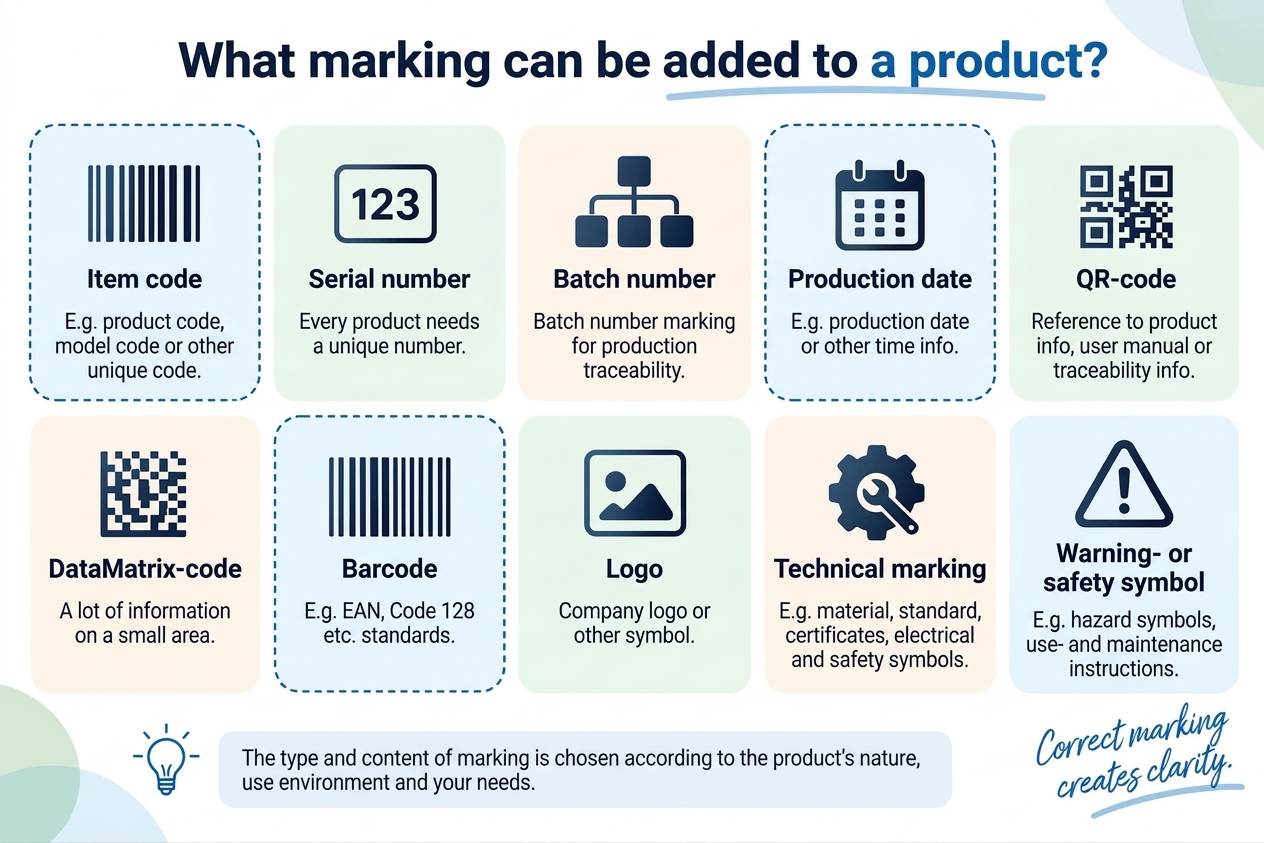
For example, when a product requires a serial number or a Data Matrix code, the marking must be precise enough to be read reliably throughout the product's lifecycle. If the component will be exposed to abrasion, chemicals, moisture, or UV radiation, the durability of the marking becomes equally important.
Before selecting a marking technology, it is worth considering at least the following questions:



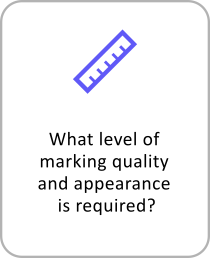

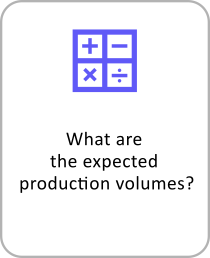
By answering these questions at an early stage, it becomes much easier to identify the marking method that provides the best balance between functionality, durability, appearance, and cost.
Laser Marking – A Precise and Flexible Solution
Laser marking uses a focused laser beam to alter the surface properties of a material or remove a very small amount of material. A key difference compared to many other marking methods is that laser marking does not apply a separate layer of ink to the component's surface. When the appropriate material and laser process are used, the marking is created directly on the material itself.
Depending on the material and the laser process used, the result may include:
Laser marking can be used to create text, logos, serial numbers, QR codes, and Data Matrix codes. It is particularly well suited for applications where the marking content may change or where a high level of precision is required.
Fiber Laser Marking Is Suitable for Many Metals and Certain Plastics
At EKOY Elektroonika, we use a Cajo Vega Desk 20 W fiber laser for laser marking, featuring a 1064 nm wavelength and a marking area of 175 × 175 mm.
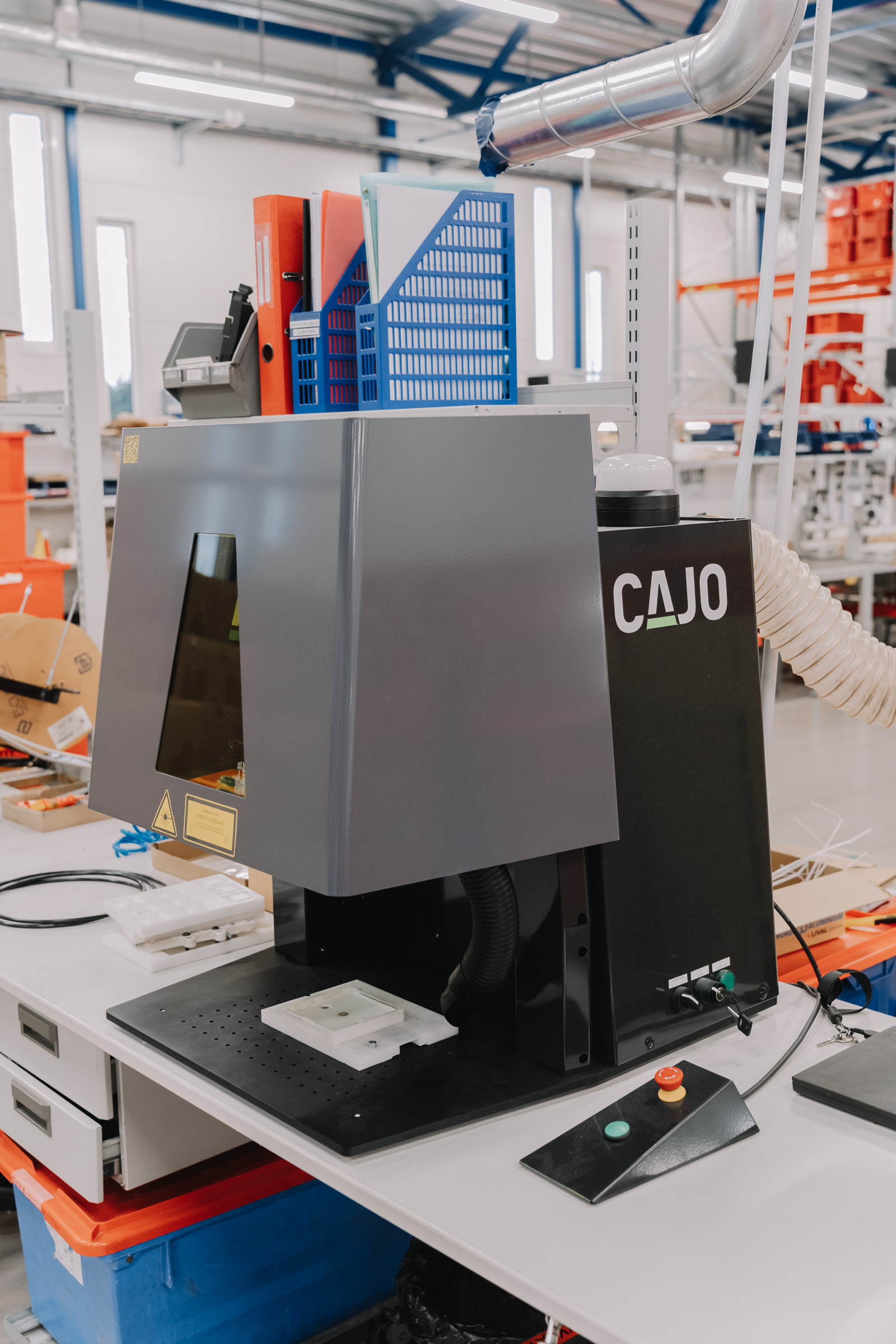
Fiber laser technology is widely used for marking metals as well as suitable plastic materials.
On metal surfaces, laser marking can produce highly visible, high-contrast marks and, with the appropriate settings, can also create deeper engravings.
When marking plastics, the result depends more heavily on the specific material properties. Factors such as the plastic composition, color pigments, and fillers play an important role. For this reason, it is not always possible to predict the appearance of a laser mark solely based on the material name.
Achieving high-quality laser marking requires the right material, properly selected parameters, and a suitable marking process.
Can All Plastic Materials Be Marked with a Laser?
No. And this is an important point for B2B customers to understand.
Plastics can react very differently to laser radiation. One material may produce a strong, high-contrast mark, while another may result in a marking that is too subtle or visually inconsistent.
The marking result can be influenced by factors such as:
For this reason, it is advisable to perform a test marking when introducing a new product. At EKOY Elektroonika, we can evaluate the marking result on a specific material before larger-scale production begins, ensuring that the marking meets the customer's expectations.
This helps reduce the risk of discovering during production that the marking lacks sufficient contrast or durability.
Laser Marking or Pad Printing?
This is often the most practical question in B2B manufacturing: should you choose laser marking or pad printing? There is no universal answer.
Pad printing is a widely used method for marking plastic components. One of its main advantages is the ability to use different colors and apply markings to surfaces with more complex shapes. For example, if a product requires a company logo in a specific color, pad printing can be an excellent solution.
Laser marking, on the other hand, offers significant advantages when durability, precision, or variable data are important. For instance, if each component needs a unique serial number or batch code, laser marking provides excellent flexibility because the marking content can be controlled digitally. In contrast, pad printing relies on a physical printing plate, meaning that different designs require preparation and changeover of tooling.
Pad Printing May Be the Better Choice If:
Not every marking application needs to be done with a laser.
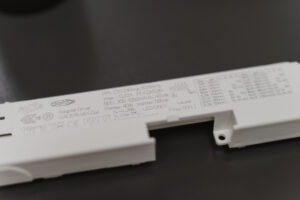
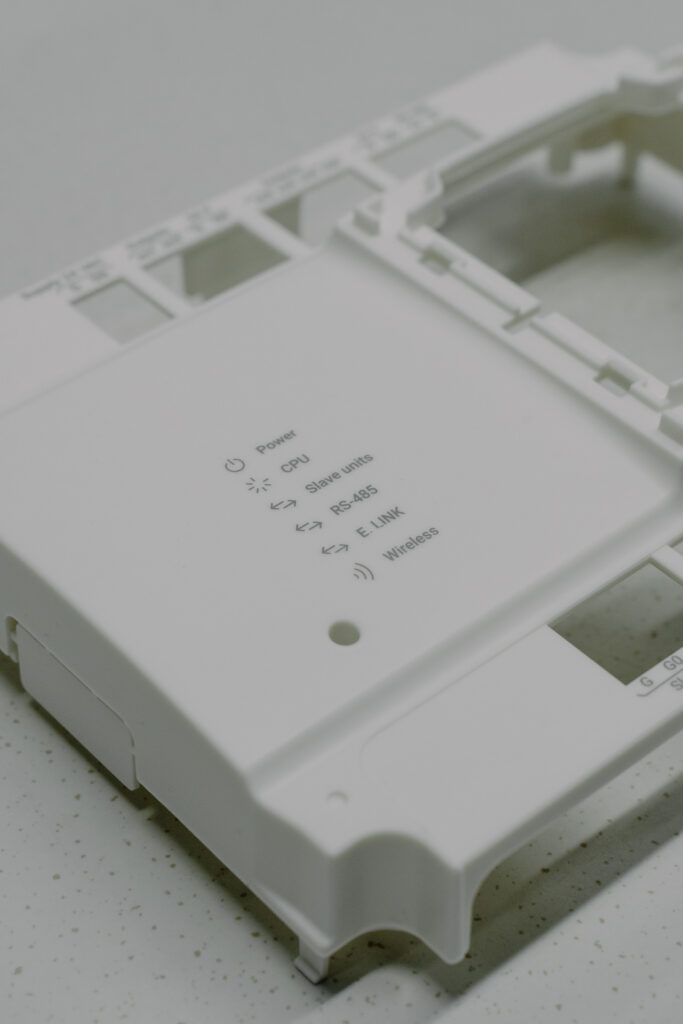
If a product requires clearly visible text, symbols, or functional markings, pad printing can be a suitable solution. In the product shown in the image, the various symbols and text have been applied using pad printing.
EKOY Elektroonika can provide both laser marking and pad printing services and help select the most suitable solution based on the product material, geometry, and marking requirements.
Laser marking becomes particularly attractive when the marking needs to be:
These characteristics make laser marking a highly suitable solution for a wide range of industrial applications.
How Durable Is Laser Marking?
This is one of the questions customers ask most frequently when considering a marking service. The durability of laser marking depends on the material being marked, the laser technology used, and the process parameters applied.
Factors that can affect durability include mechanical wear and scratching, exposure to chemicals, oils, and cleaning agents, as well as moisture, UV radiation, and temperature.
Laser marking offers an important advantage because, when the correct process is used, the result is not simply a layer of ink applied to the surface of the component. As a result, the marking can remain highly durable even under regular use and cleaning.
However, this does not mean that every laser marking will automatically withstand all possible environmental conditions. If a component is intended for use in a particularly demanding environment, the durability of the marking should be tested under representative conditions before moving into serial production.
Chemicals, Wear, and UV Exposure – What Should Be Considered?
When a marked component is exposed to oils, solvents, cleaning agents, or other chemicals, a common concern with conventional printed markings is how the ink will withstand such conditions.
With laser marking, there is no separate ink layer on the surface, which can be a significant advantage in certain applications. However, it is always important to evaluate the complete system, including both the marking and the material itself.
The same principle applies to UV exposure. For products used outdoors, it is not only important to consider whether the laser marking itself remains visible, but also how the material changes over time when exposed to sunlight and weather conditions.
For this reason, a professional marking service should always take into account the environment in which the product will be used.
Why Is Laser Particularly Suitable for Serial Numbers and Codes?
One of the practical advantages of laser marking is its ability to apply variable information to individual components.
For example, every product can be marked with a unique serial number. The marking may also include a batch number, as well as machine-readable Data Matrix or QR codes.
In these applications, marking accuracy and repeatability are essential. In addition, a digital marking process can reduce manual operator input and help minimize the risk of data-entry errors.
But What If You Need to Mark Hundreds or Thousands of Components?
At this point, not only the quality of the marking becomes important, but also the efficiency of the process. For smaller quantities, manual marking may be a perfectly reasonable solution.
For higher production volumes, however, the following questions should be considered:
At EKOY Elektroonika, we use laser marking for approximately 30 different products and have experience with both manual laser marking and automated production processes. This practical experience gives us a strong understanding of how to integrate marking operations into production as efficiently as possible.
Laser Marking Services at EKOY Elektroonika
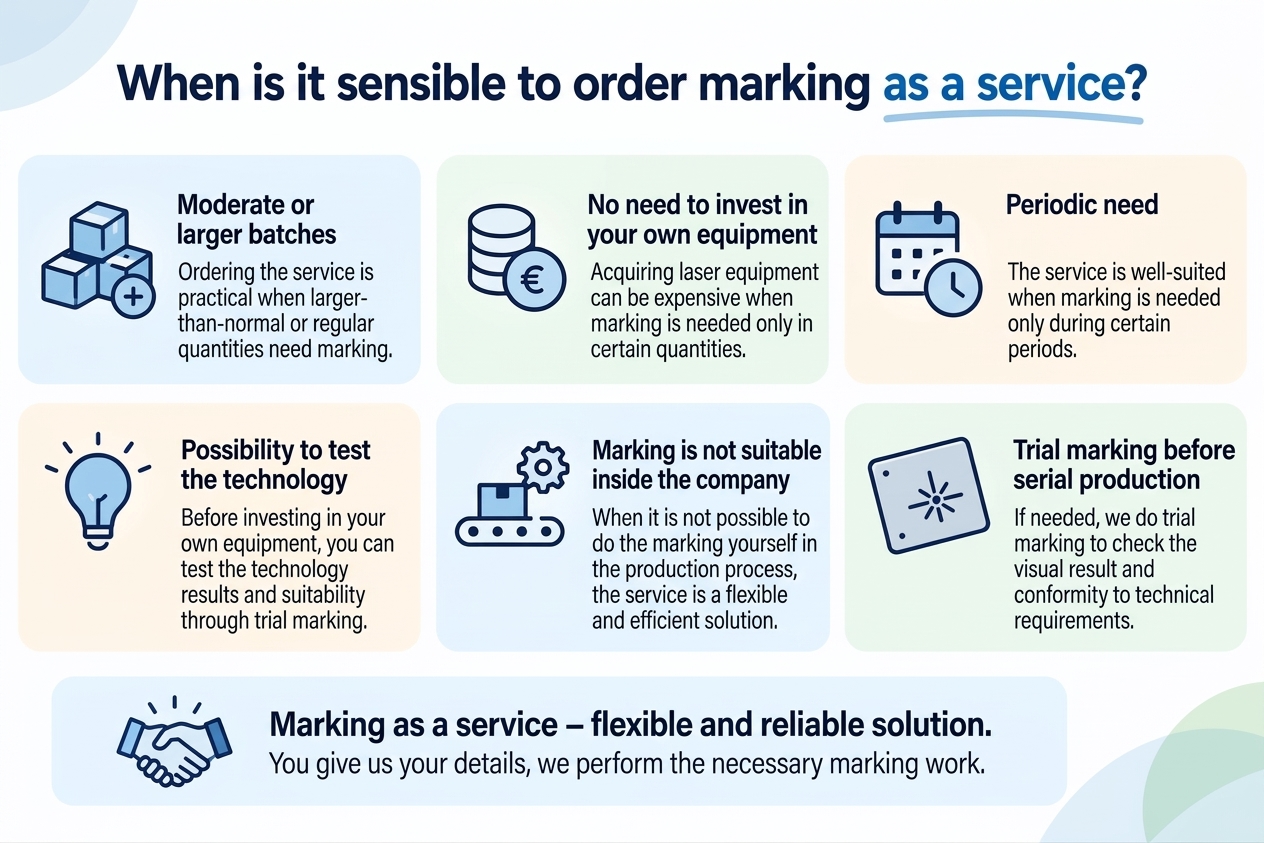
If a company requires product marking, it does not necessarily mean that investing in a laser marking system is the right solution. Marking can also be outsourced as a service.
At EKOY Elektroonika, we can provide a turnkey solution where the customer supplies the components, and we carry out the required marking operations.
We Do Not Offer Just One Technology
For customers, the most important thing is that the marking solution should not start with the assumption that, because we have a laser, everything should be marked with a laser.
A better starting point is this: you have a component that requires a specific type of marking, and our role is to identify the most suitable way to achieve it.
That is why, at EKOY Elektroonika, we evaluate different marking options before recommending a solution.
If a particular component is best suited for laser marking, we use laser technology. If a colored logo or the geometry of the component makes pad printing a better choice, we can provide pad printing. And if neither option is optimal, we can help assess alternative marking methods as well.
This approach helps avoid situations where the technology is selected before it is actually clear what result the product requires.
EKOY Elektroonika’s Experience with Laser Marking
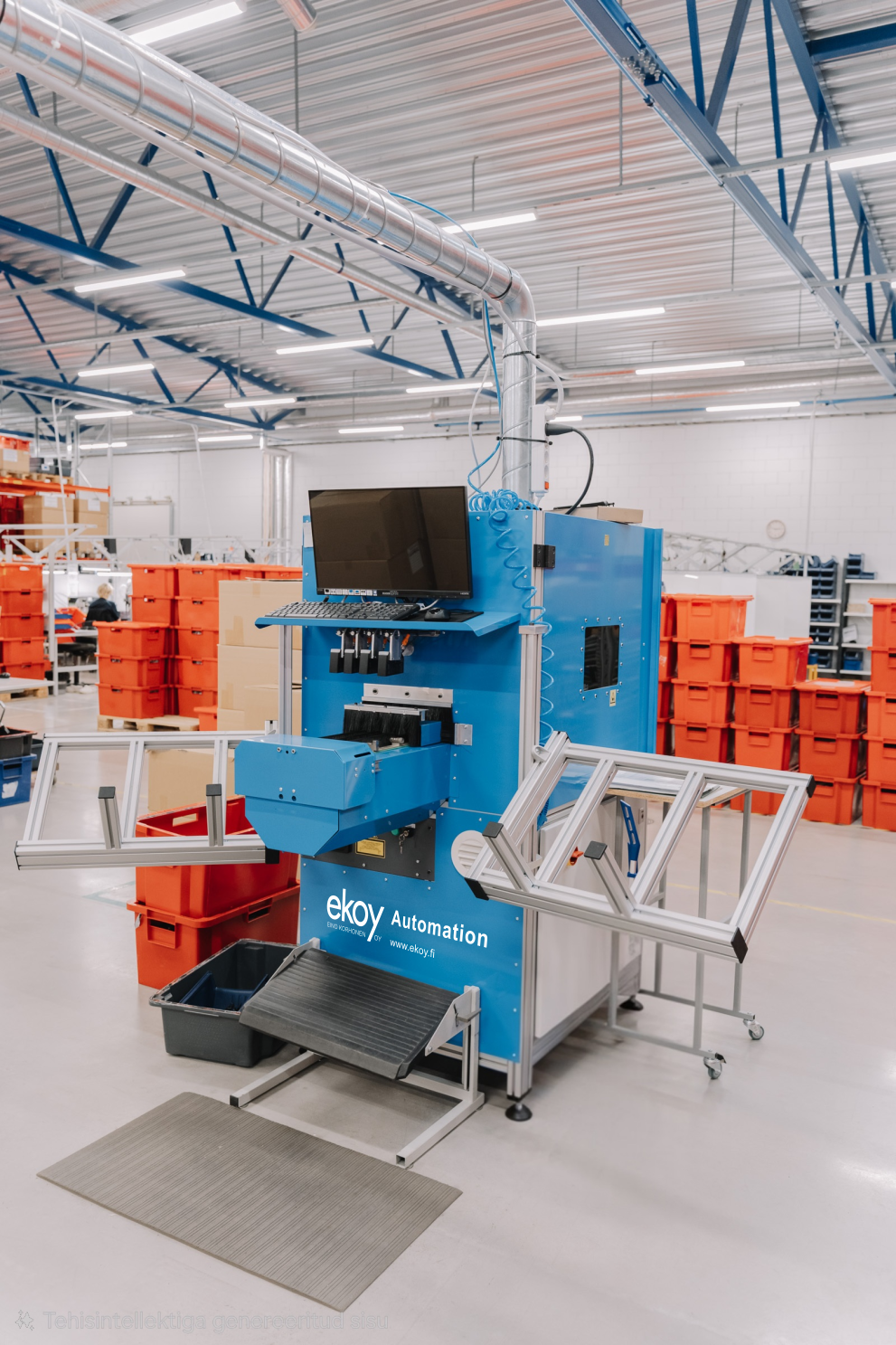
In addition to the Cajo Vega Desk 20 W fiber laser, we also use a laser marking line developed by Ekoy Automation, equipped with a Cajo Tailor Fiber 20 W laser.
This is an automated solution with a marking area of 175 × 175 mm.
This enables us to use laser marking both as a standalone service and as an integrated part of an automated production process.
In total, we have practical experience marking approximately 30 different products, working with a variety of materials and marking requirements.
However, the most important factor is not the availability of a particular machine, but the expertise to determine which marking process will deliver the desired result for a specific component.
Would Laser Marking Be Suitable for Your Product?
If you have a product or component that requires a logo, code, serial number, QR code, Data Matrix code, or other information to be added, you do not need to determine the most suitable marking technology on your own. EKOY Elektroonika can help evaluate the most appropriate marking solution and also provide marking as a service.
When needed, we begin with a test marking process to evaluate whether the desired marking provides sufficient contrast and meets visual requirements, how well it performs on the specific material, and how durable it will be under actual operating conditions. Test marking also helps identify which technology will deliver the best result for the particular component.
If laser marking is not the optimal solution for your product, we can also assess the suitability of pad printing. Our goal is not simply to offer a specific technology, but to find a practical marking solution that matches both the product requirements and production volumes.
If you would like to discuss marking options for your product, send us a drawing, photograph, or sample of the component, together with a description of the information that needs to be marked. We can then evaluate the available options and recommend the most suitable solution for your application.